
Tenjiku maru no zu|A View of Indian Elephants
6th month, 1863
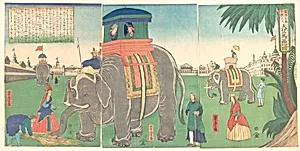
Medium
Triptych of woodblock prints; ink and color on paper
Dimensions
Image (a): 14 1/4 x 9 5/8 in. (36.2 x 24.4 cm) Image (b): 14 3/8 x 9 5/8 in. (36.5 x 24.4 cm) Image (c): 14 1/4 x 9 5/8 in. (36.2 x 24.4 cm)
Classification
Prints
Culture & Period
Japan · Edo period (1615–1868)
Department
Asian Art
Museum
Metropolitan Museum of Art, New York, NY
Credit
Bequest of William S. Lieberman, 2005
Accession Number
2007.49.213a–c
Rights
Public Domain
Tags
Art Historical Context
This striking triptych, *Tenjiku maru no zu* (“A View of Indian Elephants”), was created by Utagawa Yoshitora in the sixth month of 1863. As a woodblock print in ink and color on paper, it exemplifies the vibrant ukiyo-e tradition of Japan’s late Edo period (1615–1868). The three panels together form a wide, lively scene populated by elephants, men, women, and trees, inviting viewers to imagine an exotic spectacle rarely seen in Japan at the time. Yoshitora, a pupil of the celebrated Utagawa Kuniyoshi, specialized in colorful prints of foreign subjects. By the 1860s, after Japan’s ports reopened to international trade, such images of distant lands captured the public imagination. The triptych format, popular for its dramatic sweep, allowed Yoshitora to present the elephants at nearly life-size scale across the sheets, emphasizing their impressive presence while framing them within a lively human setting. Today in the Metropolitan Museum’s collection, the work offers a window onto a moment of cultural curiosity and artistic innovation. Its bright palette and dynamic composition demonstrate the technical brilliance of Japanese woodblock printing, preserving both the wonder of the subject and the spirit of its era.
About the Artist
Utagawa Yoshitora · 1845–1880
Utagawa Yoshitora (歌川 芳虎), also known by his art names Ichimōsai, Mōsai, and Kinchōrō, was a prolific ukiyo-e artist born in Edo (modern Tokyo), where he trained under the renowned Utagawa Kuniyoshi, recognized as his oldest pupil. Little is known of his early life, which remains sparsely documented, but his earliest works include illustrations for the book *Story of Karasu Kanzaemon’s Loyalty* in...