
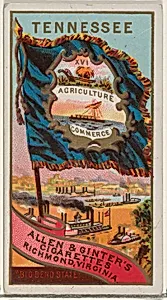
Tennessee, from Flags of the States and Territories (N11) for Allen & Ginter Cigarettes Brands
1888
Medium
Commercial color lithograph
Dimensions
Sheet: 2 3/4 x 1 1/2 in. (7 x 3.8 cm)
Classification
Prints|Ephemera
Department
Drawings and Prints
Museum
Metropolitan Museum of Art, New York, NY
Credit
The Jefferson R. Burdick Collection, Gift of Jefferson R. Burdick
Accession Number
63.350.201.11.80
Rights
Public Domain
Tags
Art Historical Context
This charming chromolithograph, *Tennessee, from Flags of the States and TerritoriesN11)*, was produced in 1888 by the tobacco company Allen & Ginter. Part of a popular series of collectible cards inserted into cigarette packs, it depicts the Tennessee state flag in vivid colors on a diminutive sheet measuring just 2¾ x 1½ inches. These tiny prints were designed as promotional ephemera, enticing smokers—often men of the era—with bite-sized bits of Americana to collect and trade. Chromolithography, the medium here, revolutionized commercial printing in the late 19th century, allowing mass production of eye-catching, multi-colored images from stone plates. Allen & Ginter, innovators in the cigarette industry, used this technique to create sets like N11, fostering a collecting craze that predated modern trading cards. Amid post-Civil War reconciliation, such cards celebrated national unity by showcasing state symbols, blending patriotism with clever marketing. Today, housed in The Metropolitan Museum of Art's Jefferson R. Burdick Collection, this card offers a window into Gilded Age consumer culture and the dawn of ephemera as art. Its preservation highlights how everyday advertising artifacts capture the spirit of their time.
About the Artist
Allen & Ginter
Allen & Ginter, the pioneering American tobacco firm based in Richmond, Virginia, emerged around 1880 from the partnership of John F. Allen and Lewis Ginter, evolving from Allen's earlier John F. Allen & Company. Allen retired in 1882, succeeded by John Pope, yet the brand endured under Ginter's leadership, employing over 1,100 workers—mostly women—for hand-rolled cigarettes by 1886. Ginter, a Dut...