
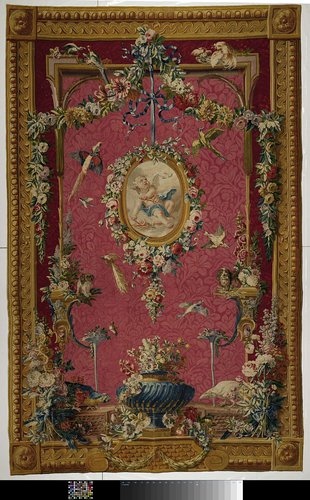
Tenture de boucher
c. 1758 - c. 1774
Medium
tapestry
Dimensions
370; 25; 235; 400
Rights
Public Domain
About this artwork
Purchased with the support of the Stichting tot Bevordering van de Belangen van het Rijksmuseum
Art Historical Context
Welcome to the Rijksmuseum's exquisite collection of 18th-century French tapestries. *Tenture de boucher created by the prestigious Manufacture Royale des Gobel around 1758–1774, is a monumental woven artwork measuring 370 cm high, 235 cm wide, cm long, and about 25 cm deep. at the royal workshop in Paris, famed for its luxurious wall hangings, this piece reflects the opulence of the Louis XV era, when tapestries served as practical insulators and dazzling displays of wealth for palaces like Versailles. The Gobelins manufactory, revived under Louis XIV and thriving mid-century, employed master weavers using haute lisse (high-warp) looms to interlace wool, silk, and sometimes gold threads into intricate designs. These labor-intensive creations—often taking years to complete—captured the refined Rococo taste, blending realism with decorative flair. While the exact imagery of *Tenture de boucher* evokes the manufactory's tradition of narrative scenes, its scale underscores its role in grand interiors. Generously acquired with support from the Stichting tot Bevordering van de Belangen van het Rijksmuseum, this tapestry bridges French royal artistry with Dutch collecting heritage, inviting us to marvel at the enduring craft of Gobelins weavers.
About the Artist
Manufacture Royale des Gobelins
The Manufacture Royale des Gobelins, a cornerstone of French decorative arts, originated in the mid-15th century as a dyeing workshop established by the Gobelin family along the Bièvre River in Paris's Faubourg Saint-Marcel. Renowned for their scarlet dye, the Gobelins supplied the foundation for what became Europe's premier tapestry factory. In 1601, King Henry IV rented the site to Flemish weave...