
BK-1975-312
ca. 1850 - ca. 1900
Medium
wool
Dimensions
130; 59
Rights
Public Domain
About this artwork
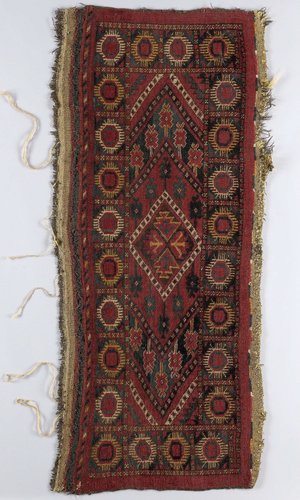
Dekkleed voor een dier. Het middenveld is versierd met een bloem binnen een ruit. Links en rechts doorsneden concentrische ruiten. Rand gearceerd met achthoeken. Boven- en onderaan een baard.
Art Historical Context
This striking wool textile, created by the Ersari people of Central Asia between 1850 and 1900, served as a decorative cover for an animal, likely a horse or camel. Such pieces reflect the nomadic lifestyle of Turkmen tribes, where functional weavings doubled as expressions of cultural identity and protection during migrations across the steppes. The design features a central field with a floral motif enclosed in a diamond shape, flanked by intersecting concentric diamonds and bordered by shaded octagons. These bold geometric patterns, woven in rich wool, are characteristic of Ersari artistry, often carrying symbolic meanings tied to tribal heritage and daily life. The fringed edges at top and bottom add both practicality and visual rhythm. Measuring just 59 by 130 centimeters, this intimate work highlights the skill of traditional weavers who transformed everyday objects into enduring art. It offers visitors a glimpse into 19th-century Central Asian traditions, where textiles conveyed status, warded off misfortune, and preserved community stories through pattern and color.