
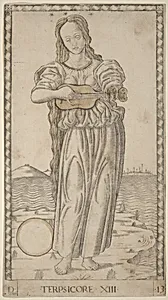
Terpsicore (Terpsichore)
Medium
engraving with gilding
Dimensions
sheet: 17.8 x 10 cm (7 x 3 15/16 in.)
Classification
Department
CG-E
Museum
National Gallery of Art, Washington, D.C.
Credit
Ailsa Mellon Bruce Fund
Accession Number
1969.6.4
Rights
Public Domain
Art Historical Context
Created around 1465 by the anonymous Master of the E-Series Tarocchi, this delicate engraving depicts Terpsichore, the Greek Muse of dance and choral song. Part of a celebrated series of 50 allegorical prints produced in northern Italy, the work reflects the Renaissance fascination with classical mythology and the liberal arts. These “tarocchi” engravings, neither playing cards nor true tarot, were prized as portable models of ideal beauty and knowledge. Measuring just 17.8 by 10 centimeters, the print showcases the emerging technique of copper engraving, enhanced here with touches of gilding that would have caught the light like a precious miniature. The fine, controlled lines and elegant pose reveal the artist’s skill in translating sculptural ideals into the new medium of print, allowing such images to circulate widely among collectors and artists. Today housed in the National Gallery of Art, this rare impression speaks to the moment when printmaking began to democratize art, carrying the grace of ancient Muses into Renaissance studies and beyond.
About the Artist
Master of the E-Series Tarocchi · 1460–1475
The Master of the E-Series Tarocchi was an anonymous Italian engraver active in Ferrara around 1465, during the vibrant era of the Este court. His early life and training remain undocumented, but stylistic affinities link him to artists collaborating with Francesco del Cossa on the frescoes of Palazzo Schifanoia's Salone dei Mesi. Working in the Ferrarese tradition, he produced the pioneering E-se...