
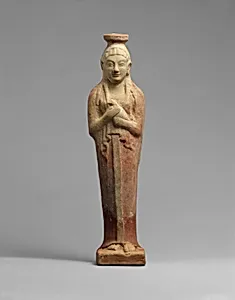
Terracotta alabastron (perfume vase) in the form of a woman holding a dove
Unknown Artist
mid-6th century BCE
Medium
Terracotta
Dimensions
10 9/16 × 2 3/4 × 3 1/16 in. (26.8 × 7 × 7.8 cm)
Classification
Vases
Culture & Period
East Greek · Archaic
Department
Greek and Roman Art
Museum
Metropolitan Museum of Art, New York, NY
Credit
Fletcher Fund, 1930
Accession Number
30.11.6
Rights
Public Domain
Tags
Art Historical Context
This charming terracotta alabastron, or perfume vase, from East Greece in the mid-6th century BCE, takes the playful form of a standing woman gently cradling a dove. Crafted during the Archaic period—a time when Greek art blossomed with lively, stylized figures—this vessel exemplifies the region's innovative pottery traditions. Standing just over 10 inches tall, its compact size made it ideal for holding scented oils or perfumes, essential luxuries in ancient daily rituals, especially for women. The unknown artisan skillfully molded the terracotta to capture the woman's graceful pose and the dove's delicate wings, blending functionality with figurative sculpture. East Greek workshops were renowned for such whimsical anthropomorphic vases, which bridged everyday objects and art, often evoking themes of femininity and nature through motifs like women and doves. These symbols appear frequently in Archaic Greek imagery, hinting at associations with love, beauty, or domestic life. Now housed in the Metropolitan Museum of Art's Greek and Roman Art department (acquired via the Fletcher Fund in 1930), this piece offers a window into the vibrant world of Archaic Greece, where beauty was as practical as it was poetic. Visitors can appreciate how such vases turned routine self-care into a sculptural delight.