
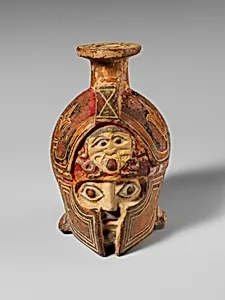
Terracotta aryballos in the form of a helmeted head
Unknown Artist
ca. 600–575 BCE
Medium
Terracotta
Dimensions
2 15/16 × 1 3/4 × 2 in. (7.4 × 4.5 × 5.1 cm)
Classification
Vases
Culture & Period
East Greek · Archaic
Department
Greek and Roman Art
Museum
Metropolitan Museum of Art, New York, NY
Credit
Rogers Fund, 1941
Accession Number
41.162.74
Rights
Public Domain
Tags
Art Historical Context
This delightful terracotta aryballos shaped like a helmeted head,ails from East Greek workshops during the Archaic period (. 600–575 BCE). Measuring just under 3 inches tall, petite vase functioned as a flask for perfumed oils or athletic unguents, a practical item for ancient Greeks who prized personal grooming and sport. Its whimsical anthropomorphic form—complete with a crested helmet—transforms a everyday object into a playful sculptural portrait, blending utility with artistic imagination. East Greek potters were renowned for such innovative plastic vases, molding clay into lively three-dimensional figures that capture the era's vibrant spirit. The helmet evokes the armored warriors central to Archaic Greek culture, reflecting heroic ideals from epic tales like the Iliad amid the period's political and artistic flowering. Terracotta's fired clay medium allowed for durable, portable designs, often enhanced with slips or paints (though details here are subtle). Now in the Metropolitan Museum of Art's Greek and Roman Art collection, thanks to the Rogers Fund of 1941, this aryballos offers visitors a tangible window into Archaic life's fusion of function, mythology, and craftsmanship.