
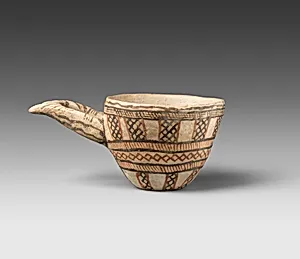
Terracotta bowl
Unknown Artist
ca. 1600–1450 BCE
Medium
Terracotta
Dimensions
H. 2 1/4 in. (5.7 cm) diameter 3 3/16 in. (8.1 cm)
Classification
Vases
Culture & Period
Cypriot · Late Cypriot I
Department
Greek and Roman Art
Museum
Metropolitan Museum of Art, New York, NY
Credit
The Cesnola Collection, Purchased by subscription, 1874–76
Accession Number
74.51.1115
Rights
Public Domain
Art Historical Context
This delicate terracotta bowl, crafted around 1600–1450 BCE during Cyprus's Late Cypriot I period offers a glimpse into the Bronze Age world of the eastern Mediterranean. Measuring just 2¼ inches high and 3⅛ inches in diameter, its modest scale suggests it was likely used for everyday purposes—perhaps serving food, liquids, or even in rituals common to Cypriot households. As a product of an unknown artisan, it exemplifies the island's vibrant pottery tradition, where terracotta vessels were essential for storage, trade, and daily life. Terracotta, or fired clay, was prized for its durability and versatility, allowing potters to shape functional forms on wheels or by hand before low-temperature firing. In Late Cypriot I, Cyprus flourished as a cultural crossroads between the Aegean, Near East, and Egypt, fostering distinctive ceramics that supported a booming maritime economy. This bowl's simple, wheel-made profile highlights the technical skill of local workshops, which produced wares exported across the region. Acquired as part of The Cesnola Collection (purchased by subscription in 1874–76), it now resides in The Metropolitan Museum of Art's Greek and Roman Art department. Such artifacts illuminate Cyprus's overlooked role in ancient connectivity, reminding us how humble objects preserve the stories of forgotten makers.