
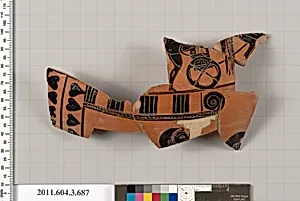
Terracotta fragment of a hydria (water jar)
Unknown Artist
third quarter of the sixth century BCE
Medium
Terracotta
Classification
Vases
Culture & Period
Greek, Attic · Archaic
Department
Greek and Roman Art
Museum
Metropolitan Museum of Art, New York, NY
Credit
Gift of Dietrich von Bothmer, Distinguished Research Curator, Greek and Roman Art, 2011
Accession Number
2011.604.3.687
Rights
Public Domain
Art Historical Context
This terracotta fragment from a hydria, or water jar, transports us to Attic Greece in the third quarter of the century BCE, during the vibrant Archaic period. Crafted an unknown artist, it represents the pinnacle of early Greek pottery production in Athens, where workshops churned out vessels for both daily use and export across the Mediterranean. Hydriai like this one, with their distinctive three handles—two horizontal for lifting and one vertical for pouring—were vital items, often carried by women to public fountains, symbolizing domestic life in ancient society. Attic potters of this era mastered the black-figure technique, painting figures in glossy black slip on the red-orange clay body, then incising details to reveal the underlying color. Though only a fragment survives, it hints at the narrative scenes—myths, rituals, or everyday moments—that adorned such jars, showcasing Archaic artists' growing skill in storytelling and anatomy before the shift to red-figure pottery. These vases were not just functional; they were cultural ambassadors, reflecting Greek innovation and aesthetic refinement. Generously gifted to the Metropolitan Museum of Art in 2011 by Dietrich von Bothmer, this piece invites us to ponder the lives of those who shaped and used it, bridging 2,500 years of human creativity.