
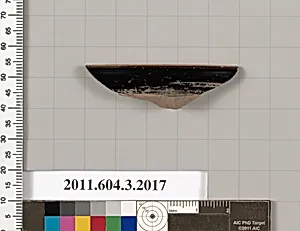
Terracotta fragment of a kylix (drinking cup)?
Unknown Artist
second half of the 6th century BCE
Medium
Terracotta
Classification
Vases
Culture & Period
Greek, Attic · Archaic
Department
Greek and Roman Art
Museum
Metropolitan Museum of Art, New York, NY
Credit
Gift of Dietrich von Bothmer, Distinguished Research Curator, Greek and Roman Art, 2011
Accession Number
2011.604.3.2017
Rights
Public Domain
Art Historical Context
This delicate terracotta fragment from a kylix—a shallow, stemless drinking cup—offers a glimpse into the vibrant world of Archaic Greek pottery from Attic Athens, dating to the second half of the 6th century BCE. Produced during a time when Athens was emerging as a cultural powerhouse, such vases were luxuries, crafted from fired clay and often adorned with painted scenes of mythology, athletics, or daily life. only a fragment survives, it exemplifies the technical mastery of Attic potters, who fired terracotta to a fine, durable finish suitable for both utility and art. Kylikes held special cultural significance in ancient symposia, the all-male drinking parties central to Greek social and intellectual life, where wine was mixed with water and philosophical debates flowed. Attic vases from this Archaic period (c. 700–480 BCE) represent a pinnacle of early Greek ceramics, bridging functional objects and storytelling through decoration. This piece, generously gifted to the Metropolitan Museum of Art in 2011 by Dietrich von Bothmer, esteemed curator of Greek and Roman Art, enriches our understanding of these ancient traditions. (178 words)