
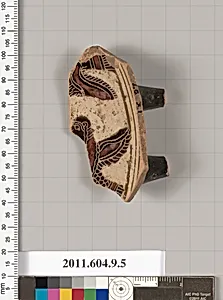
Terracotta fragment of a kylix (drinking cup)
mid-6th century BCE
Medium
Terracotta
Classification
Vases
Culture & Period
Greek, Laconian · Archaic
Department
Greek and Roman Art
Museum
Metropolitan Museum of Art, New York, NY
Credit
Gift of Dietrich von Bothmer, Distinguished Research Curator, Greek and Roman Art, 2011
Accession Number
2011.604.9.5
Rights
Public Domain
Art Historical Context
This terracotta fragment of alix, or drinking cup, offers a glimpse into the vibrant world of Archaic Greek pottery from the mid-6th century BCE. Created in the Laconian region of ancient Greece—associated with Sparta—the piece reflects the cultural importance of communal drinking rituals known as symposia. Such vessels were not merely functional but served as canvases for artistic expression, often exchanged as gifts or used in elite gatherings to foster social bonds. Attributed to the Rider Painter, a notable figure in Laconian vase painting, the fragment highlights the distinctive black-figure technique popular this era. Artists applied slip to terracotta and fired it to create contrasting black silhouettes against the natural clay, allowing for dynamic scenes that celebrated athleticism, mythology, and daily life. The Rider Painter’s name derives from his frequent depictions of horsemen, underscoring themes of mobility and status in Spartan society. As part of the Metropolitan Museum’s Greek and Roman Art collection, this work exemplifies how even fragmentary artifacts illuminate broader artistic traditions. Its donation by curator Dietrich von Bothmer further connects modern scholarship with ancient craftsmanship, inviting visitors to appreciate the enduring legacy of Laconian innovation within the Archaic period’s evolving aesthetic.