
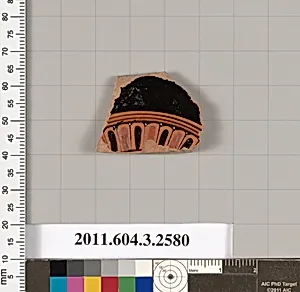
Terracotta fragment of a Little Master cup (drinking cup)
Unknown Artist
second quarter of the 6th century BCE
Medium
Terracotta
Classification
Vases
Culture & Period
Greek, Attic · Archaic
Department
Greek and Roman Art
Museum
Metropolitan Museum of Art, New York, NY
Credit
Gift of Dietrich von Bothmer, Distinguished Research Curator, Greek and Roman Art, 2011
Accession Number
2011.604.3.2580
Rights
Public Domain
Art Historical Context
This delicate terracotta fragment comes from a Little Master cup, a type of elegant drinking vessel crafted in Attic Greece during the second quarter of the th century BCE, in the Archaic period. Produced in Athens, these cups were sympotic wares—used in lively social gatherings where wine flowed and stories were shared. As a fragment, it offers a tantalizing glimpse into ancient craftsmanship, likely featuring the black-figure technique where figures were painted in glossy black slip and incised to reveal red clay beneath. Little Master cups represent a specialized innovation by anonymous Athenian potters and painters, nicknamed for their tiny, lively figures arranged in narrow friezes around the cup's lip or body. This style marked a shift toward miniaturization and precision in Archaic vase-painting, bridging the robust black-figure tradition with emerging red-figure experiments. Such vessels highlight the Greek obsession with symmetry, mythology, and daily life, often depicting gods, heroes, or athletes in dynamic scenes. Generously gifted to the Metropolitan Museum of Art in 2011 by Dietrich von Bothmer, a renowned curator of Greek and Roman art, this piece invites us to ponder the hands that shaped it over 2,500 years ago—hands that captured the vibrancy of ancient Athenian culture in fired clay.