
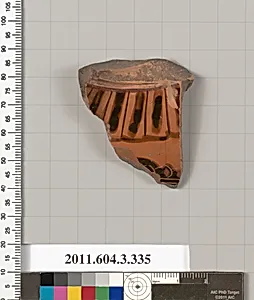
Terracotta fragment of a neck-amphora (jar)
Unknown Artist
late 6th/early 5th centuries BCE
Medium
Terracotta
Classification
Vases
Culture & Period
Greek, Attic · Archaic
Department
Greek and Roman Art
Museum
Metropolitan Museum of Art, New York, NY
Credit
Gift of Dietrich von Bothmer, Distinguished Research Curator, Greek and Roman Art, 2011
Accession Number
2011.604.3.335
Rights
Public Domain
Art Historical Context
This terracotta fragment from a neck-amphora, dating to the late 6th or early 5th century BCE, offers a glimpse into the vibrant world of Archaic Attic pottery from ancient Greece. Produced in Athens, the heart of Greek ceramic innovation, neck-amphoras were practical two-handled jars used to store and transport olive oil or wine—essentials of daily life and trade. As a fragment, it survives from what was once a complete vessel, likely decorated with the black-figure technique, where figures were painted in glossy black slip and details incised to reveal the red clay beneath. This method, perfected by Attic workshops, marked a high point of Archaic artistry before the shift to red-figure styles. Though the artist remains unknown, the piece exemplifies the technical mastery and cultural storytelling of Attic vase-painters. These vessels weren't just utilitarian; they graced symposia (elite drinking parties) and exported Greek myths worldwide, spreading Athenian influence across the Mediterranean. Archaic pottery bridged the Geometric and Classical eras, capturing a time of burgeoning democracy, epic poetry, and monumental temple-building. Generously gifted to the Metropolitan Museum of Art in 2011 by Dietrich von Bothmer, this fragment invites us to ponder the hands that shaped it millennia ago—artisans whose work endures as a window into everyday ancient life.