
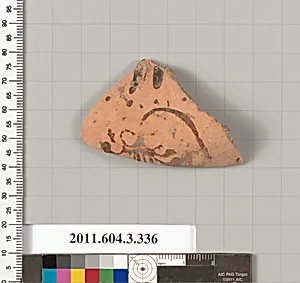
Terracotta fragment of a neck-amphora (jar)
Unknown Artist
last quarter of the 6th century BCE
Medium
Terracotta
Classification
Vases
Culture & Period
Greek, Attic · Archaic
Department
Greek and Roman Art
Museum
Metropolitan Museum of Art, New York, NY
Credit
Gift of Dietrich von Bothmer, Distinguished Research Curator, Greek and Roman Art, 2011
Accession Number
2011.604.3.336
Rights
Public Domain
Art Historical Context
This terracotta fragment from a neck-amphora, to the last quarter of the 6th century, offers a glimpse into the vibrant of Archaic Greek pottery from Attic workshops. A neck-amphora was a practical two-handled jar designed for storing and transporting precious commodities like olive oil or wine, its elegant neck facilitating easy pouring. Crafted in terracotta—fired clay renowned for its durability—this piece exemplifies the technical mastery of Athenian potters during a golden age of vase production. In the Archaic period (c. 600–480 BCE), Attic ceramics were not just utilitarian but also canvases for storytelling, often adorned in the black-figure technique. Silhouettes of figures were painted in glossy black slip, incised with details, and fired in kilns to create a striking contrast against the orange clay. Though only a fragment survives, it reflects the export-driven industry that spread Greek myths and daily life across the Mediterranean, influencing cultures from Etruria to the Black Sea colonies. Generously gifted to the Metropolitan Museum of Art in 2011 by Dietrich von Bothmer, a pioneering curator of Greek and Roman art, this shard connects us to ancient artisans whose innovations paved the way for classical masterpieces. A humble survivor, it whispers of feasts, trade, and timeless craftsmanship.