
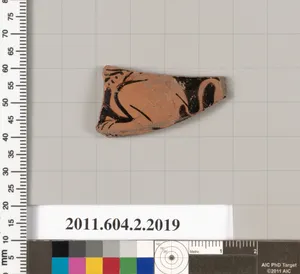
Terracotta fragment of an askos (flask with a spout and handle over the top)
Unknown Artist
late 5th century BCE
Medium
Terracotta
Classification
Vases
Culture & Period
Greek, Attic · Classical
Department
Greek and Roman Art
Museum
Metropolitan Museum of Art, New York, NY
Credit
Gift of Dietrich von Bothmer, Distinguished Research Curator, Greek and Roman Art, 2011
Accession Number
2011.604.2.2019
Rights
Public Domain
Art Historical Context
This terracotta fragment from an askos, a distinctive ancient Greek flask with a spout and arched handle, dates to the late 5th century BCE, the height of Athens' Classical period. Crafted in Attic workshops—renowned for their exquisite pottery—this piece reflects the ingenuity of everyday Greek vessels. Askoi like this were practical yet elegant, designed for pouring oils, perfumes, or unguents in households, symposia, or religious rituals, embodying the blend of utility and artistry in classical life. Though only a fragment survives, it offers a glimpse into Attic terracotta techniques: hand-formed clay fired to a warm reddish hue, often adorned with intricate red-figure painting that left figures in reserve against a black-gloss background. This period marked a pinnacle of Greek vase-making, where potters and painters collaborated anonymously to capture myths, daily scenes, and human forms with lifelike grace, influencing art across the Mediterranean. A generous gift to the Metropolitan Museum of Art from Dietrich von Bothmer in 2011, this shard highlights how even broken pieces preserve cultural memory, revealing the sophistication of Athenian craftsmanship amid the era of Pericles and the Parthenon.