
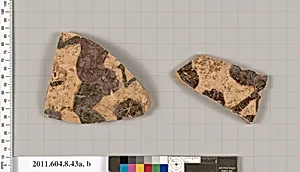
Terracotta fragments of a closed shape
Unknown Artist
6th century BCE
Medium
Terracotta
Classification
Vases
Culture & Period
Greek, Corinthian? · Corinthian?
Department
Greek and Roman Art
Museum
Metropolitan Museum of Art, New York, NY
Credit
Gift of Dietrich von Bothmer, Distinguished Research Curator, Greek and Roman Art, 2011
Accession Number
2011.604.8.43a, b
Rights
Public Domain
Art Historical Context
These terracotta fragments from a closed-shape vase offer a tantalizing glimpse into the vibrant world of 6th-century BCE Greece. Dating to the Archaic period, they likely belong to a Corinthian workshop, a powerhouse of ancient pottery production known for its crafted vessels. Closed shapes, such as small perfume flasks or oil containers, were essential for daily life, trade, and rituals, often carried by travelers across the Mediterranean. Crafted from fired clay, these pieces highlight the technical mastery of Corinthian potters, who excelled in wheel-thrown forms and durable terracotta that withstood centuries. Though incomplete, the fragments evoke the bustling pottery industry of Corinth, whose wares influenced Greek art from Athens to the Black Sea colonies. Black-figure decoration—typical of the era—may have once adorned them, depicting myths, athletes, or daily scenes in stark silhouette against a reddish clay background. Generously gifted to the Metropolitan Museum of Art in 2011 by Dietrich von Bothmer, a legendary curator of Greek and Roman art, these shards remind us how even broken remnants preserve cultural stories. They underscore Corinth's role as an artistic innovator, bridging the Orientalizing style and the classical ideals to come.