
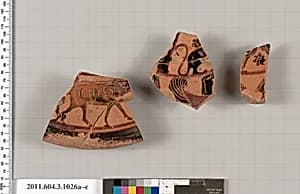
Terracotta fragments of a lid
Unknown Artist
mid-6th century BCE
Medium
Terracotta
Classification
Vases
Culture & Period
Greek, Attic · Archaic
Department
Greek and Roman Art
Museum
Metropolitan Museum of Art, New York, NY
Credit
Gift of Dietrich von Bothmer, Distinguished Research Curator, Greek and Roman Art, 2011
Accession Number
2011.604.3.1026a–c
Rights
Public Domain
Art Historical Context
These delicate terracotta fragments from a vase lid, dating to the mid-6th century BCE, offer a glimpse into the vibrant world of Archaic Attic Greece. Crafted by an unknown artist during a period of artistic innovation, they belong to the height of black-figure pottery production in Athens, where potters and painters collaborated to create functional yet beautifully decorated objects. Such lids sealed storage jars, oil containers, or symposium vessels, blending everyday utility with aesthetic appeal in ancient households and rituals. Terracotta, a fired clay medium, was prized for its durability and versatility, allowing intricate wheel-thrown forms and painted details that captured mythological scenes, daily life, or abstract patterns—hallmarks of the Archaic style. Though fragmented, these pieces highlight the technical prowess of Attic workshops, whose vases were traded across the Mediterranean, spreading Greek culture far and wide. Their survival speaks to the enduring legacy of this era, bridging the geometric motifs of earlier periods and the refined red-figure techniques to come. Generously gifted to the Metropolitan Museum of Art in 2011 by Dietrich von Bothmer, a renowned curator of Greek and Roman art, these fragments invite us to ponder the hands that shaped them over 2,500 years ago. A testament to ancient ingenuity!