
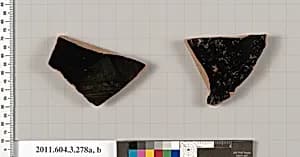
Terracotta fragments of amphorae (jars)
Unknown Artist
6th/5th centuries BCE
Medium
Terracotta
Classification
Vases
Culture & Period
Greek, Attic · Archaic
Department
Greek and Roman Art
Museum
Metropolitan Museum of Art, New York, NY
Credit
Gift of Dietrich von Bothmer, Distinguished Research Curator, Greek and Roman Art, 2011
Accession Number
2011.604.3.278a, b
Rights
Public Domain
Art Historical Context
These terracotta fragments from Archaic Attic amphorae, dating to the 6th or 5th century BCE, offer a glimpse into the daily life and artistry of ancient Greece. Amphorae were essential two-handled jars used for storing and transporting goods like olive oil, wine, and, playing a vital role in trade across the Mediterranean. Crafted in Attica—the heartland of classical Athens—these vessels exemplify the period's pottery production, a cornerstone of Greek material culture. Though incomplete, the fragments highlight the durability of terracotta, fired clay that preserved scenes of mythology, daily activities, or geometric patterns through techniques like black-figure painting, which emerged in this era. Attic vases were not just functional but also artistic exports, spreading Greek influence far and wide. Their survival underscores the Archaic period's transition toward the refined Classical style. Generously gifted to the Metropolitan Museum of Art in 2011 by Dietrich von Bothmer, a renowned curator of Greek and Roman art, these pieces invite us to piece together the vibrant world of ancient Athens—where utility met creativity in everyday clay