
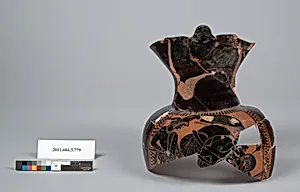
Terracotta fragments of an oinochoe (jug)
Unknown Artist
510 BCE
Medium
Terracotta
Dimensions
6 1/4 × 5 9/16 in. (15.9 × 14.1 cm) Height (without handle): 6 1/16 in. (15.4 cm)
Classification
Vases
Culture & Period
Greek, Attic · Archaic
Department
Greek and Roman Art
Museum
Metropolitan Museum of Art, New York, NY
Credit
Gift of Dietrich von Bothmer, Distinguished Research Curator, Greek and Roman Art, 2011
Accession Number
2011.604.3.779
Rights
Public Domain
Art Historical Context
These terracotta fragments from an Attic oinochoe, or wine jug, date to 510 BCE, the waning years of Greece's Archaic period. Crafted in Athens, the epicenter of ancient Greek pottery production, this small vessel—asuring just over 6 inches tall without its handle—would have served a practical purpose in symposia, the lively social gatherings where wine was and poured. Oinochoai like this were everyday essentials, yet their survival as archaeological treasures offers a window into Archaic daily life and craftsmanship. Terracotta, fired clay, was the medium of choice for such vases, valued for its durability and suitability for intricate decorations (though details here are lost to fragmentation). Attic potters excelled in techniques like black-figure painting, where incised figures emerged from a glossy black slip, blending utility with artistry. This piece exemplifies the period's transition toward the more refined Classical style, highlighting Athens' role as a cultural powerhouse. Generously gifted to the Metropolitan Museum of Art in 2011 by Dietrich von Bothmer, a pioneering scholar of Greek art, these fragments enrich our understanding of Archaic Greece. Though incomplete, they evoke the vibrancy of ancient rituals and the skill of unnamed artisans whose work shaped Western art.