
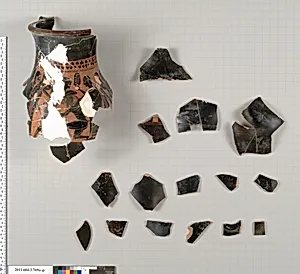
Terracotta fragments of an oinochoe: olpe (jug)
Unknown Artist
third quarter of the sixth century BCE
Medium
Terracotta
Classification
Vases
Culture & Period
Greek, Attic · Archaic
Department
Greek and Roman Art
Museum
Metropolitan Museum of Art, New York, NY
Credit
Gift of Dietrich von Bothmer, Distinguished Research Curator, Greek and Roman Art, 2011
Accession Number
2011.604.3.769a–p
Rights
Public Domain
Art Historical Context
These delicate terracotta fragments come from an oinochoe, specifically an olpe—a graceful with a trefoil spout designed for pouring wine. Crafted in Attic Greece during the third quarter of the sixth century BCE (roughly 575–550 BCE), this piece belongs to the Archaic period, a time when Athens flourished as a hub of artistic innovation. Though incomplete, the fragments offer a glimpse into everyday luxury, evoking the lively symposia where such vessels played a starring role in social rituals. Attic terracotta vases like this one were masterpieces of black-figure pottery, a technique where artisans incised details into fired clay silhouettes before adding vibrant details. This method, peaking in the Archaic era, allowed for intricate scenes of mythology, daily life, and athletics that celebrated Greek ideals of beauty and heroism. Exported across the Mediterranean, these jugs symbolized cultural prestige and technical prowess. Generously gifted to the Metropolitan Museum of Art in 2011 by Dietrich von Bothmer, a legendary curator of Greek and Roman art, these shards remind us how even broken pieces preserve profound stories. They connect us to an ancient world where form met function in elegant harmony.