
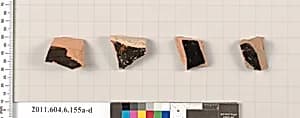
Terracotta fragments of open shapes
Unknown Artist
6th/5th centuries BCE
Medium
Terracotta
Classification
Vases
Culture & Period
Greek, Attic · Archaic/Classical
Department
Greek and Roman Art
Museum
Metropolitan Museum of Art, New York, NY
Credit
Gift of Dietrich von Bothmer, Distinguished Research Curator, Greek and Roman Art, 2011
Accession Number
2011.604.6.155a–d
Rights
Public Domain
Art Historical Context
These terracotta fragments of open shapes hail from Attic Greece during the Archaic and Classical periods (6th–5th centuries BCE), a golden age of ancient pottery production. Crafted in the region around Athens, these pieces are remnants of vases—likely shallow vessels such as kylikes (drinking cups) or bowlsdesigned for everyday use, symposia (social drinking parties), and ritual offerings. Attica was the epicenter of Greek ceramics, exporting wares across the Mediterranean and influencing countless cultures. Terracotta, a fired clay medium, was prized for its durability and versatility. Artisans shaped the clay on a potter's wheel, refined it through multiple kiln firings, and often decorated it with intricate black-figure or early red-figure techniques (though these fragments preserve the vessel forms themselves). Such pottery offers invaluable insights into ancient Greek life, from domestic rituals to artistic innovation, bridging the stylized Archaic era and the more naturalistic Classical style. Generously gifted to the Metropolitan Museum of Art in 2011 by Dietrich von Bothmer, a legendary curator of Greek and Roman art, these fragments remind us of the skilled, anonymous hands behind enduring masterpieces. Though incomplete, they evoke the vibrancy of ancient Athens and invite us to piece together the past.