
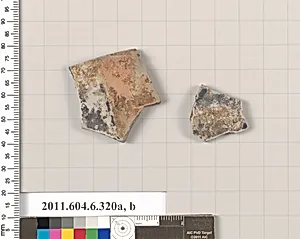
Terracotta fragments of undetermined shapes
Unknown Artist
6th/5th centuries BCE
Medium
Terracotta
Classification
Vases
Culture & Period
Greek, Attic · Archaic/ Classical
Department
Greek and Roman Art
Museum
Metropolitan Museum of Art, New York, NY
Credit
Gift of Dietrich von Bothmer, Distinguished Research Curator, Greek and Roman Art, 2011
Accession Number
2011.604.6.320a, b
Rights
Public Domain
Art Historical Context
These enigmatic terracotta fragments, dating to the 6th or 5th century BCE offer a glimpse into the vibrant of Attic Greek pottery during the Archaic and Classical. Produced in ancient Athens, the heart of artistic innovation, these vase shards—though of undetermined shapes—belong to a tradition of everyday and ceremonial vessels that were essential to Greek life. Terracotta, fired valued for its durability andability, allowed potters to create functional objects that doubled as canvases for storytelling through painted decoration. Attic vases from this era are renowned for pioneering techniques like black-figure (silhouetted figures incised with details) and the revolutionary red-figure style, where backgrounds were painted black to highlight natural clay figures. Even in fragments, they preserve echoes of myths, daily scenes, or athletic prowess, reflecting the cultural ideals of heroism, beauty, and piety. These pieces highlight the anonymous mastery of Athenian workshops, where skilled artisans elevated humble clay into high art exported across the Mediterranean. Generously gifted to the Metropolitan Museum of Art in 2011 by Dietrich von Bothmer, a legendary curator of Greek and Roman art, these fragments remind us how archaeological puzzles piece together ancient narratives. Though incomplete, they embody the enduring allure of Archaic and Classical Greece, inviting us to imagine the hands that shaped them millennia ago.