
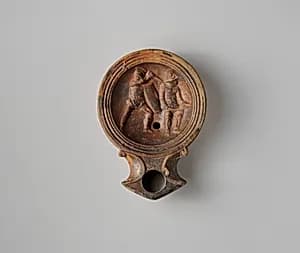
Terracotta oil lamp
Unknown Artist
1st half of 1st century CE
Medium
Terracotta
Dimensions
Overall: 1 1/4 x 4 3/8 in. (3.2 x 11.1 cm)
Classification
Terracottas
Culture & Period
Roman · Early Imperial
Department
Greek and Roman Art
Museum
Metropolitan Museum of Art, New York, NY
Credit
The Cesnola Collection, Purchased by subscription, 1874–76
Accession Number
74.51.1938
Rights
Public Domain
Tags
Art Historical Context
This delicate terracotta oil lamp, crafted in the early Imperial Roman period (first half of the 1st century CE), offers a glimpse into everyday life in ancient Rome. During the reign of emperors like Augustus and Tiberius, such lamps were essential household items, providing soft, flickering light from olive oil and a wick. Measuring just 1¼ x 4⅜ inches, its compact size made it ideal for tables, walls, or portable use, illuminating homes, workshops, and public spaces across the empire. Made from molded terracotta—a fired clay valued for its affordability and durability—this lamp exemplifies Roman mass-production techniques. Artisans pressed wet clay into two-part molds, allowing for intricate details like nozzles for the wick and filling holes, often decorated with figural motifs. The tag "Men" hints at male figures, possibly in mythological scenes or daily activities, reflecting Roman cultural emphasis on heroism, labor, or domestic rituals. Part of The Cesnola Collection at The Metropolitan Museum of Art, acquired through public subscription in 1874–76, this unassuming artifact underscores the artistry in utilitarian objects. It reminds us how Romans blended function with subtle decoration, bridging the mundane and the monumental in their world.