
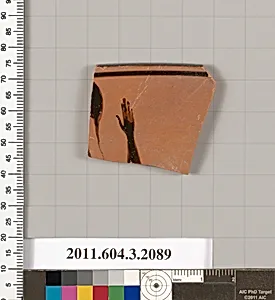
Terracotta rim fragment of a kylix (drinking cup)
Unknown Artist
late 6th/early 5th centuries BCE
Medium
Terracotta
Classification
Vases
Culture & Period
Greek, Attic · Archaic
Department
Greek and Roman Art
Museum
Metropolitan Museum of Art, New York, NY
Credit
Gift of Dietrich von Bothmer, Distinguished Research Curator, Greek and Roman Art, 2011
Accession Number
2011.604.3.2089
Rights
Public Domain
Art Historical Context
This terracotta rim fragment from a kylix, a shallow drinking cup popular in ancient Greece, dates to the late 6th or early 5th century BCE during the Archaic period. Produced in Attica, the heart of classical Greek pottery, kylikes were essential for symposia—lively social gatherings where men reclined, drank wine diluted with water, and discussed philosophy, politics, and poetry. Even as a modest fragment, it offers a glimpse into everyday elite life in Athens, a time when the city-state was flourishing culturally and artistically. Attic potters mastered terracotta techniques, firing clay at high temperatures and decorating with slip (liquid clay) in black-figure or emerging red-figure styles. This rim likely framed scenes of myths, athletes, or revelers painted in vibrant detail, showcasing the precision and narrative skill of anonymous workshops. The Archaic period bridged the rigid Geometric style and the more naturalistic Classical era, making such vases key exports that spread Greek influence across the Mediterranean. Generously gifted to the Metropolitan Museum of Art in 2011 by scholar Dietrich von Bothmer, this piece highlights the enduring value of fragments in reconstructing ancient artistry. Though small, it embodies the ingenuity of Greek craftsmen and invites us to ponder the voices and visions echoing from antiquity.