
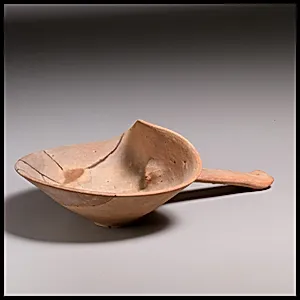
Terracotta scuttle
Unknown Artist
ca. 1400–1190 BCE
Medium
Terracotta
Dimensions
Length with handle 10 3/8 in. (16.3 cm.)
Classification
Terracottas
Culture & Period
Mycenaean · Late Helladic IIIA-B
Department
Greek and Roman Art
Museum
Metropolitan Museum of Art, New York, NY
Credit
Gift of the Greek Government, 1927
Accession Number
27.120.9
Rights
Public Domain
Art Historical Context
This charming terracotta scuttle, to around 1400–1190 BCE, hails from the Mycenaean culture of Late Helladic IIIA-B, a pivotal era in Bronze Age Greece. Measuring just 10 3/8 inches long its handle, this modest vessel exemplifies the everyday pottery produced in Mycenaean workshops, likely used for scooping and carrying liquids, grains, or household goods. Mycenaeans, famed for their grand palaces like those at Pylos and Mycenae, relied on such practical terracottas alongside their more lavish bronze and ivory works. Crafted from fired clay—a durable, abundant medium— the scuttle highlights Mycenaean potters' skill in shaping functional forms by hand or on a simple wheel, then firing them in kilns for strength. These objects offer a window into domestic life during a time of thriving trade, Linear B script administration, and epic myths that would inspire Homer's tales. Now at the Metropolitan Museum of Art, thanks to a 1927 gift from the Greek Government, this unassuming piece underscores the cultural richness of Mycenaean society, bridging elite artistry with the rhythms of ordinary existence. A testament to enduring craftsmanship!