
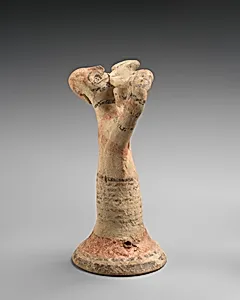
Terracotta statuette of a male flute-player
Unknown Artist
ca. 750–600 BCE
Medium
Terracotta
Dimensions
H. 5 7/8 in. (14.9 cm)
Classification
Terracottas
Culture & Period
Cypriot · Cypro-Archaic I
Department
Greek and Roman Art
Museum
Metropolitan Museum of Art, New York, NY
Credit
The Cesnola Collection, Purchased by subscription, 1874–76
Accession Number
74.51.1691
Rights
Public Domain
Tags
Art Historical Context
This charming terracotta statuette depicts a male flute-player from Cyprus, dating to the Cypro-Aric I period (ca. 750–600 BCE). Standing just under 6 inches tall, the figure captures a musician in mid-performance, pipes to his lips, embodying the lively role of music in everyday Cypriot life. Crafted from fired clay—a favored medium in Cyprus for its accessibility and durability—this small votive or decorative object likely served in household shrines or tombs, reflecting the island's blend of local traditions with influences from Greece, the Near East, and Egypt. Terracotta figurines like this one flourished during Cyprus's Archaic era, when artisans hand-modeled figures with simple tools, adding details like clothing folds or instruments for vivid realism. The flute-player highlights music's cultural prominence, possibly evoking banquets, rituals, or festivals where aulos players entertained. As part of The Cesnola Collection at the Metropolitan Museum of Art—assembled in the 1870s through public subscription—this piece offers a window into Cyprus's vibrant artistic world, bridging the gap between utility and artistry. Imagine the soft notes filling an ancient Cypriot home—step closer and let this little musician transport you back over 2,500 years!