
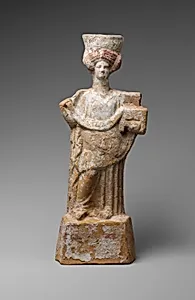
Terracotta statuette of a standing woman with a basket and wreath
Unknown Artist
late 5th century BCE
Medium
Terracotta
Dimensions
h. 14 1/8 in. (35.9 cm)
Classification
Terracottas
Culture & Period
Greek, Boeotian · Classical
Department
Greek and Roman Art
Museum
Metropolitan Museum of Art, New York, NY
Credit
Gift of Ernest Brummer, 1959
Accession Number
59.48.23
Rights
Public Domain
Tags
Art Historical Context
This graceful terracotta statuette depicts a standing woman holding a basket, or *kalathos*, in hand and wearing a wreath on her head, evoking the rituals and daily life of ancient Greece. Crafted in Boeotia—a region in central Greece known for its vibrant terracotta workshops—during the late 5 century BCE, it dates to the Classical period, a golden age of artistic refinement and philosophical inquiry. At just over 14 inches tall, the figure stands poised and elegant, her simple drapery and attributes suggesting she may represent a devotee or participant in a festival honoring fertility deities like Demeter. Terracotta, or baked clay, was a versatile and accessible medium in ancient Greece, allowing artisans to mold detailed figures quickly for both household use and religious dedications. Boeotian workshops excelled in producing such votive statuettes, often left as offerings in sanctuaries to seek divine favor. The woman's wreath and basket symbolize abundance and celebration, common motifs in women's cult practices, highlighting the integral role of females in Greek religious and social spheres. Today, this poignant artifact graces the Metropolitan Museum of Art's Greek and Roman Art department, a gift from Ernest Brummer in 1959. It offers a intimate glimpse into Boeotian piety and artistry, bridging the gap between everyday devotion and timeless beauty.