
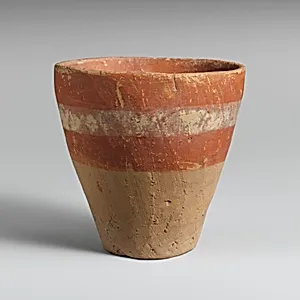
Terracotta tumbler
Unknown Artist
ca. 2100–1950 BCE
Medium
Terracotta
Dimensions
H. 3 in. (7.6 cm.) Greatest diameter 2 15/16 in. (7.5 cm.)
Classification
Vases
Culture & Period
Minoan · Middle Minoan IA
Department
Greek and Roman Art
Museum
Metropolitan Museum of Art, New York, NY
Credit
The Cesnola Collection, by exchange, 1911
Accession Number
11.186.6
Rights
Public Domain
Art Historical Context
This delicate terracotta tumbler, to around 2100–1950 BCE, hails from the vibrant Minoan culture on Crete during the Middle Minoan IA period—the dawn of Crete's sophisticated Bronze Age palaces like Knossos. Standing just 3 inches tall with a nearly matching diameter, this small vase was likely a humble drinking vessel for everyday use, reflecting the Minoans' mastery of pottery for both practical and ritual purposes. Crafted from fired clay, the tumbler's simple, rounded form exemplifies early Minoan wheel-thrown techniques, which allowed for uniform shapes and efficient production. Minoan pottery evolved rapidly in this era, transitioning from handmade wares to more refined vessels that hinted at emerging trade networks across the Aegean. Though undecorated, its survival speaks to the durability of terracotta and the Cesnola Collection's role in preserving such artifacts through exchange in 1911. Housed in the Metropolitan Museum of Art's Greek and Roman Art department, this tumbler offers a window into Minoan daily life, where even modest objects underscored a thriving society known for its seafaring prowess and artistic innovation long before classical Greece.