
Terracotta vase in the form of a lion
Unknown Artist
2nd century CE
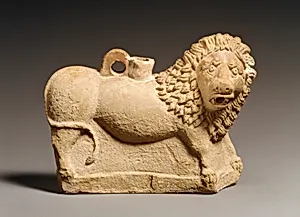
Medium
Terracotta
Dimensions
4 1/2 x 5 7/8in. (11.4 x 14.9cm)
Classification
Vases
Culture & Period
Roman · Mid Imperial
Department
Greek and Roman Art
Museum
Metropolitan Museum of Art, New York, NY
Credit
The Cesnola Collection, Purchased by subscription, 1874–76
Accession Number
74.51.1666
Rights
Public Domain
Tags
Art Historical Context
This delightful terracotta vase, crafted in the form of a lion during Rome's Mid-Imperial period the 2nd century, captures the empire's fascination with powerful animal motifs. Standing just 4½ x 5⅞ inches (11.4 x 14.9 cm), its compact size suggests it was designed for practical use—perhaps holding oils, perfumes, orents—while doubling as a decorative or ritual object. Lions, evoking strength, ferocity, and imperial might, were popular symbols in Roman art, often linked to gods like Hercules or the exotic wildlife of conquered territories. Terracotta, a fired clay medium abundant and versatile, allowed artisans to mold intricate forms like this zoomorphic vase with relative ease. The technique highlights Roman ceramic expertise, blending functionality with whimsy; the lion's stylized features reflect influences from Greek prototypes while embracing imperial eclecticism. Such vessels were common in households, tombs, or sanctuaries, bridging everyday life and the divine. Now housed in the Metropolitan Museum of Art's Greek and Roman Art Department as part of the Cesnola Collection (acquired 1874–76), this piece offers a tangible glimpse into Roman material culture, reminding us how ancient makers infused utility with symbolic power.