
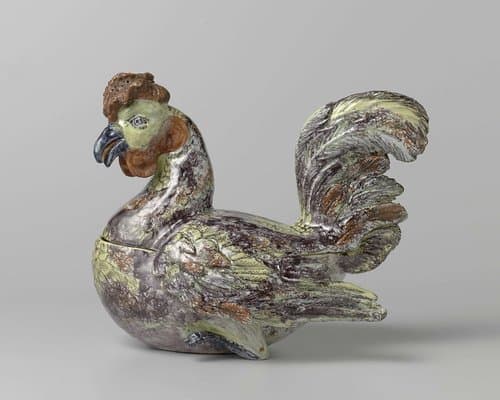
Terrine van faïence in de vorm van een kip
c. 1750 - c. 1780
Medium
tureen
Dimensions
31
Rights
Public Domain
About this artwork
Gift of the heirs of J.F. Loudon, The Hague
Art Historical Context
Behold the whimsical *Terrine van faï in de vorm van een*, a tin-glazed earthenware t crafted anonymously around 1750–1780. Measuring about 31 cm in length, this charming serving dish takes the playful form of a plump chicken complete with detailed feathers, beak, and tail—its lid likely doubling as the creature's crest. Such zoomorphic designs transformed everyday tableware into delightful conversation pieces, blending utility with artistry. Produced during the height of the Rococo era in the Netherlands, this piece exemplifies Dutch *faïence* from centers like Delft, where potters mastered tin-glazing techniques to mimic luxurious Chinese porcelain at affordable prices. The opaque white glaze provided a vibrant canvas for painted motifs, though here the focus is on sculptural molding, showcasing the era's love for nature-inspired whimsy and opulent dining displays among the bourgeoisie. A generous gift from the heirs of J.F. Loudon in The Hague, this tureen offers a glimpse into 18th-century domestic splendor, reminding us how food service once rivaled fine art in elegance and imagination.
About the Artist
anonymous
In the vast tapestry of art history, "Anonymous" stands not as a singular individual but as a collective designation for countless unidentified creators whose works have endured across millennia. These artists, spanning prehistoric cave painters to medieval illuminators and folk craftsmen, produced the foundational layers of human visual culture. Prior to the Renaissance, when individual fame emer...