
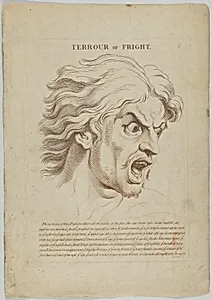
Terrour or Fright (from "Heads Representing the Various Passions of the Soul; as they are Expressed in the Human Countenance: Drawn by that Great Master Monsieur Le Brun")
Medium
Engraving with etching
Dimensions
Plate: 11 1/4 x 7 1/4 in. (28.6 x 18.4 cm)
Classification
Prints
Department
Drawings and Prints
Museum
Metropolitan Museum of Art, New York, NY
Credit
The Elisha Whittelsey Collection, The Elisha Whittelsey Fund, 1953
Accession Number
53.638.31(20-14)
Rights
Public Domain
Tags
Art Historical Context
This engraving, titled *Terrour or Fright*, belongs to a celebrated 18th-century series illustrating the human passions as originally conceived by the great French artist Charles Le Brun. Le Brun, a leading figure at the court of Louis XIV and director of the Académie Royale, created expressive head studies to explore how emotions register on the face—an endeavor that blended art, anatomy, and philosophy. Published in London in 1765 by Robert Sayer, this British print after Le Brun’s design made those ideas widely accessible to a new audience of artists, actors, and curious viewers. Rendered in engraving with etching, the work captures a man’s face contorted by sudden alarm: wide eyes, raised brows, and parted lips convey the raw intensity of fear. The medium’s fine lines allow for precise rendering of facial muscles, reflecting the period’s growing interest in physiognomy and emotional expression. As part of a larger set titled *Heads Representing the Various Passions of the Soul*, the print served both as an artistic reference and a cultural mirror of Enlightenment fascination with the inner life made visible. Today housed in the Metropolitan Museum of Art’s collection of drawings and prints, this sheet continues to invite viewers to read emotion through line and gesture.
About the Artist
Charles Le Brun|Robert Sayer|Anonymous, British, 18th century · 1619–1690
Charles Le Brun (1619–1690) was the most powerful artistic figure in seventeenth-century France, serving as the virtual dictator of official taste during the reign of Louis XIV and shaping the visual identity of the French Baroque in ways that resonated for generations. Born in Paris, he trained under the painter Simon Vouet before traveling to Rome in 1642, where he studied the works of Nicolas P...