
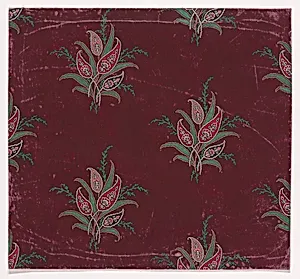
Textile Design with Bundles of Paisley Motifs, Stylized Leaves and Stylized Branches with Leaves
Medium
Gouache
Dimensions
Sheet: 8 1/8 × 8 3/4 in. (20.7 × 22.3 cm)
Classification
Drawings|Ornament & Architecture
Department
Drawings and Prints
Museum
Metropolitan Museum of Art, New York, NY
Credit
Museum Accession, transferred from the Library
Accession Number
1978.671.5(1.1)
Rights
Public Domain
Art Historical Context
This delicate gouache drawing, created anonymously by an Alsatian artist in 0, showcases a textile design brimming with bundles of Paisley motifs alongside stylized leaves and branches. Measuring just 8 1/8 × 8 3/4 inches, this compact sheet captures the precision of pattern-making for fabrics, likely intended as a prototype for printed textiles. Housed in the Metropolitan Museum of Art's Drawings and Prints department, exemplifies the ornamental designs that fueled Europe's booming textile trade. In the 19th century, Alsace—straddling France and Germany—was a powerhouse of textile innovation, particularly in printed cottons from cities like Mulhouse. The Paisley motif, inspired by Persian and Indian shawls imported via Kashmir, exploded in popularity across Europe during this era, symbolizing exotic luxury and romanticism. European designers stylized these intricate pinecone shapes into versatile patterns for shawls, dresses, and home goods, blending Eastern influences with Western manufacturing prowess. Gouache, with its opaque, vibrant pigments, was ideal for these designs, allowing artists to render vivid colors and fine details on paper before committing to looms. This piece highlights the artistry behind everyday fashion, inviting us to appreciate the anonymous craft that shaped 19th-century style.