
Textile Fragment
Unknown Artist
5th–6th century
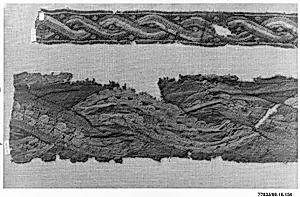
Medium
Wool, linen; plain weave, tapestry weave
Dimensions
Max. H. 2 1/4 in. (5.7 cm) Max. W. 6 in. (15.2 cm)
Classification
Textiles
Department
Islamic Art
Museum
Metropolitan Museum of Art, New York, NY
Credit
Purchase by subscription, 1889
Accession Number
89.18.154
Rights
Public Domain
Art Historical Context
This delicate textile fragment, dating to the 5th–6th centuries, offers a glimpse into the sophisticated weaving traditions of the early medieval Near East. Crafted from wool and linen using plain weave for the foundation and tapestry weave for decorative elements, it exemplifies the technical prowess of anonymous artisans from a region later associated with Islamic culture. Though small—measuring just 2¼ inches high by 6 inches wide—this fragment survives as a testament to everyday materials transformed into functional yet artistic objects, likely part of clothing, furnishings, or ceremonial items. The combination of plain weave, a simple over-under interlacing for durability, and tapestry weave, where colored weft threads create patterns without a ground fabric, highlights advanced pre-Islamic textile techniques. These methods, common in Coptic Egypt and Sassanian Persia, allowed for vibrant motifs and intricate designs that persisted into Islamic art. Acquired by the Metropolitan Museum of Art through subscription purchase in 1889, it resides in the Islamic Art Department, underscoring the continuity of weaving heritage across cultures. For visitors, this unassuming piece reveals how textiles were cultural carriers—preserving dyes, patterns, and skills that bridged ancient worlds. Though details of its exact design are fragmented, it invites wonder at the hands that wove it over 1,500 years ago.