
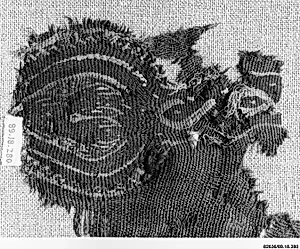
Textile Fragment
Unknown Artist
4th century
Medium
Wool, linen; plain weave, tapestry weave
Dimensions
H. 5 in. (12.7 cm) W. 5 in. (12.7 cm)
Classification
Textiles
Department
Islamic Art
Museum
Metropolitan Museum of Art, New York, NY
Credit
Purchase by subscription, 1889
Accession Number
89.18.280
Rights
Public Domain
Art Historical Context
This delicate textile fragment, dating to the 4th, offers a glimpse into the sophisticated weaving traditions of the ancient Near East or Egypt during the late antique period. Crafted from wool and linen using plain weave for the foundation and tapestry weave for decorative elements, it measures just 5 by 5 inches—small enough to have adorned a garment, curtain, or furnishing. Acquired by the Metropolitan Museum of Art through subscription purchase in 1889 it resides in the Islamic Art department highlighting the continuity of textile arts from pre-Islamic eras into later Islamic cultures. The use of tapestry weave, where colored wefts are inserted selectively to create patterns without floats, demonstrates remarkable technical skill and allowed for vibrant, durable motifs—likely geometric or figurative designs typical of the time. Wool provided warmth and colorfastness, while linen added strength, reflecting materials abundant in trade routes connecting the Mediterranean and Asia. Such fragments are rare survivors, preserved perhaps by Egypt's arid sands, and reveal everyday artistry amid the Roman, Byzantine, and Sasanian influences of the 4th century. For museum visitors, this piece underscores textiles' cultural role: not just functional, but a canvas for storytelling and status. Imagine it as part of a larger tapestry, bustling with life from a world 1,600 years past.