
Textile Fragment
Unknown Artist
3rd–4th century
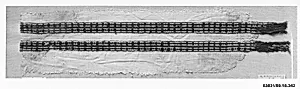
Medium
Wool, linen; plain weave, tapestry weave
Dimensions
H. 25 1/4 in. (64.1 cm) W. 6 in. (15.2 cm)
Classification
Textiles
Department
Islamic Art
Museum
Metropolitan Museum of Art, New York, NY
Credit
Purchase by subscription, 1889
Accession Number
89.18.342
Rights
Public Domain
Art Historical Context
This delicate textile fragment, dating to the 3rd–4th century, offers a glimpse into the sophisticated weaving traditions of late antiquity. Crafted from wool and linen using plain weave for the foundation and tapestry weave for decorative elements, it measures a slender 25¼ inches high by 6 inches wide. by the Metropolitan Museum of Art through purchase in 1889, it resides in the Department of Islamic Art, highlighting enduring relevance to the region's cultural heritage. The combination of plain weave—a sturdy, everyday technique—and tapestry weave, which allows for intricate, pictorial designs, underscores the skill of anonymous artisans. These methods were essential for creating garments, furnishings, and trade goods in the ancient Near East or Egypt, where textiles served as symbols of status and artistry. Surviving fragments like this are rare, preserved often by Egypt's arid sands, and reflect the vibrant exchange of ideas along ancient trade routes. Though details of its exact motif or use remain elusive due to its fragmentary state, this piece embodies the technical innovation and aesthetic refinement that paved the way for later Islamic textile traditions, inviting us to appreciate the quiet mastery of early weavers.