
Textile Fragment
Unknown Artist
3rd–4th century
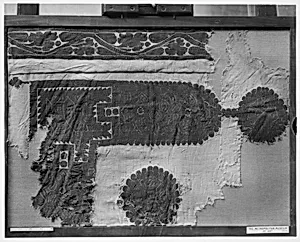
Medium
Wool, linen; plain weave, tapestry weave
Dimensions
Max. H. 28 15/16 in. (73.5 cm) Max. W. 21 7/16 in. (54.5 cm)
Classification
Textiles
Department
Islamic Art
Museum
Metropolitan Museum of Art, New York, NY
Credit
Purchase by subscription, 1889
Accession Number
89.18.354
Rights
Public Domain
Art Historical Context
This striking Textile Fragment, dating to the 3rd–4th century, offers a glimpse into the sophisticated textile traditions of the ancient Near East or Egypt, now housed in the Metropolitan Museum of Art's Department of Islamic Art. Crafted from wool and linen using plain weave for the foundation and tapestry weave for decorative elements, it measures an impressive 28 15/16 by 21 7/16 inches (73.5 by 54.5 cm). Acquired through a subscription purchase in 1889, this fragment exemplifies the durability and artistry of early woven goods, likely part of a larger garment, curtain, or wall hanging. The dual weaving techniques highlight masterful craftsmanship: plain weave provided a sturdy base, while tapestry weave allowed for vibrant, pictorial patterns where colored weft threads completely covered the warp, creating bold motifs without needing dyes on the linen ground. Such methods were labor-intensive, requiring skilled weavers to interlock threads seamlessly, and were prized for their ability to depict figures, animals, or geometric designs—hallmarks of Late Antique textiles that influenced later Islamic art. Culturally, these fragments bridge pre-Islamic and early Islamic worlds, underscoring textiles' role in daily life, trade, and status. Preserved in arid environments, they reveal a vibrant color palette from natural dyes and the era's global exchanges along Silk Road routes, inviting us to imagine the hands that wove them centuries ago.