
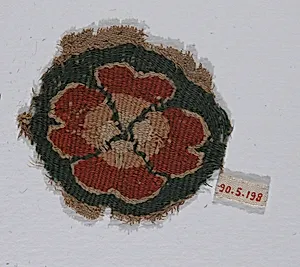
Textile Fragment
Unknown Artist
4th–5th century
Medium
Wool, linen; tapestry weave
Classification
Textiles
Department
Islamic Art
Museum
Metropolitan Museum of Art, New York, NY
Credit
Gift of George F. Baker, 1890
Accession Number
90.5.198
Rights
Public Domain
Art Historical Context
This exquisite *Textile Fragment* from the th–5th century a glimpse into the masterful textile traditions of the Late Antique world, now housed in the Metropolitan Museum of's Department of Islamic Art. Craft by an unknown artist using wool and linen in a tapestry weave technique, it exemplifies an ancient method where colored weft yarns are woven discontinuously to create vibrant, pictorial patterns directly in the fabric. This labor-intensive process allowed for rich, durable designs that adorned garments, hangings, and, surviving centuries thanks to Egypt's arid climate, where many such fragments originated. Dating to a pivotal era bridging classical antiquity and the rise of Islam, this piece reflects the cultural exchanges across the Mediterranean and Near East. Tapestry weaves like this were prized for their technical sophistication and symbolic motifs—often animals, figures, or geometrics—that conveyed status and spirituality. Though small, the fragment preserves the ingenuity of early weavers, whose work influenced later Islamic textile arts renowned for opulence and abstraction. A generous gift from George F. Baker in 1890, it invites us to marvel at these unsung artisans, whose threads wove stories of daily life and devotion into history's fabric.