
Textile Fragment
Unknown Artist
5th century
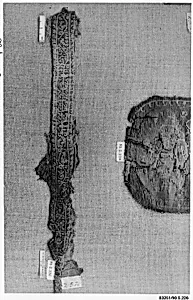
Medium
Wool, linen; plain weave, tapestry weave
Dimensions
H. 13 3/4 in. (35 cm) W. 13/16 in. (2 cm)
Classification
Textiles
Department
Islamic Art
Museum
Metropolitan Museum of Art, New York, NY
Credit
Gift of George F. Baker, 1890
Accession Number
90.5.226
Rights
Public Domain
Art Historical Context
This delicate textile fragment, dating to the 5th century, offers glimpse into the sophisticated weaving of the early medieval Near East or Egypt, preserved in the Metropolitan Museum of Art's Department of Islamic Art. Measuring just 13¾ inches high and a slender 13/16 inch wide, it survives as a narrow strip, likely part of a larger garment, furnishing, or ritual object. Gifted to the Museum in 1890 by F. Baker, it exemplifies the fragility and rarity of ancient textiles, which rarely endure due to their organic materials. Crafted from wool and linen using plain weave for the ground and tapestry weave for decorative elements, the fragment highlights advanced technical skill. Plain weave provided a sturdy base, while tapestry weave—where weft threads completely cover the warp—allowed for vibrant, pictorial motifs typical of the era. These techniques, bridging late antique and early Islamic cultures, underscore textiles' role as everyday art forms, conveying status, spirituality, and trade connections across the Mediterranean and beyond. Though details of its imagery or exact provenance remain elusive, this piece connects visitors to a world where weaving was both craft and cultural narrative, influencing the opulent textile traditions that would flourish in later Islamic societies. A testament to anonymous mastery, it invites us to marvel at the hands that wove history itself.