
Textile Fragment
Unknown Artist
4th–5th century
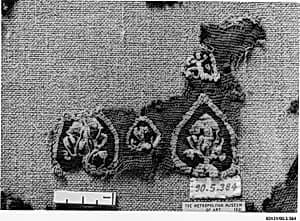
Medium
Wool, linen; plain weave, tapestry weave
Dimensions
Max. H. 3 1/8 in. (8 cm) Max. W. 2 3/4 in. (7 cm)
Classification
Textiles
Department
Islamic Art
Museum
Metropolitan Museum of Art, New York, NY
Credit
Gift of George F. Baker, 1890
Accession Number
90.5.384
Rights
Public Domain
Art Historical Context
This exquisite *Textile Fragment* from the 4th–5th invites us into the world of Late Antique weaving, a time of vibrant cultural exchange across the Near East and Mediterranean. Crafted by an unknown artist from wool and, it measures a modest 3 1/8 by 2 3/4 inches, yet survives as a rare testament to everyday artistry. Now in the Metropolitan Museum of Art's Islamic department—thanks to a 1890 gift from George F. Baker—it exemplifies the textiles classified within this collection, bridging pre-Islamic traditions with later developments. The piece masterfully combines plain weave, a simple over-under structure prized for its durability in garments and household items, with tapestry weave. This technique interlocks colorful weft threads to fully cover the warp, enabling bold patterns without a loom's full width—ideal for small-scale production. Such methods highlight the weavers' skill in dyeing and design, producing fragments that once adorned clothing or furnishings. In the Islamic Art context, this tiny survivor underscores textiles' cultural role: portable art forms that fueled trade along ancient routes. Its preservation reveals how wool and linen endured centuries, offering precious insights into techniques that influenced Islamic textile traditions for generations. A small window, indeed, into a vast woven heritage!