
Textile Fragment
Unknown Artist
5th century
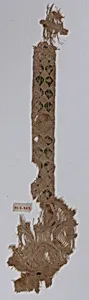
Medium
Wool, linen; plain weave, tapestry weave
Dimensions
Max. H. 20 7/8 in. (53 cm) Max. W. 3 in. (7.6 cm)
Classification
Textiles
Department
Islamic Art
Museum
Metropolitan Museum of Art, New York, NY
Credit
Gift of George F. Baker, 1890
Accession Number
90.5.569
Rights
Public Domain
Art Historical Context
This delicate Textile Fragment, dating to the 5th, offers a rare glimpse into early textile artistry from the Islamic world. Crafted from wool and linen using plain weave and tapestry weave techniques, it just 20⅞ inches high and 3 inches wide—likely a surviving piece of a larger garment, furnishing, or ritual object. Housed in the Metropolitan Museum of Art's Islamic Art Department it entered the collection as a gift from George. Baker in 1890, preserving a tangible link to ancient craftsmanship. In the 5th century, textiles were among the most prized artifacts in daily life and trade across regions that would shape Islamic culture, from Egypt to Central Asia. Plain weave provided a sturdy foundation, while tapestry weave allowed artisans to create intricate, discontinuous patterns by interweaving colored wefts— a labor-intensive method that highlighted skill and storytelling without wasting precious yarn. Though the artist remains unknown, such fragments reveal the sophistication of pre-Islamic weaving traditions that influenced later Islamic opulence. Today, this modest survivor captivates with its enduring colors and textures, reminding us how textiles wove together commerce, religion, and artistry in antiquity. A testament to anonymous hands, it invites us to ponder the lives it once adorned.