
Textile Fragment
Unknown Artist
4th–5th century
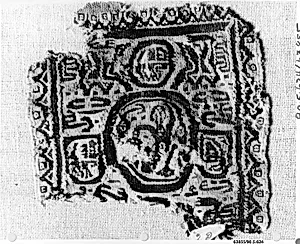
Medium
Wool, linen; tapestry weave
Dimensions
Max. H. 5 3/16 in. (13.2 cm) Max. W. 5 in. (12.7 cm)
Classification
Textiles
Department
Islamic Art
Museum
Metropolitan Museum of Art, New York, NY
Credit
Gift of George F. Baker, 1890
Accession Number
90.5.624
Rights
Public Domain
Art Historical Context
This delicate textile fragment, dating to 4th–5th century, offers a rare glimpse into the weaving traditions of the early medieval Near East. Crafted from wool and linen in a weave—a labor-intensive technique where colored weft threads are woven discontinuously to form patterns directly in the fabric—this small piece (just over 5 inches square) survives as a testament to ancient craftsmanship. Such methods, requiring great skill, produced vibrant, durable textiles prized for clothing, furnishings, and trade across regions now associated with Islamic art. Housed in the Metropolitan Museum of Art's Department of Islamic Art, thanks to a 1890 gift from George F. Baker, the fragment highlights the cultural continuum between late antique and early Islamic worlds. During this era, textile production flourished in areas like Egypt, Syria, and Persia, where wool and linen were abundant and techniques like tapestry weave influenced later Islamic opulence—think of the intricate carpets and robes that defined caliphal courts. Though tiny, it evokes bustling workshops and far-flung caravan routes. For visitors, this unassuming survivor underscores how everyday materials carried artistic prestige, preserving colors and motifs that might otherwise be lost to time. A humble yet profound link to antiquity!