
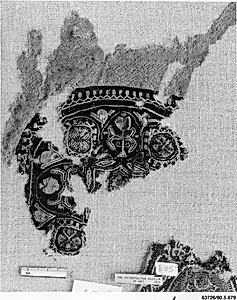
Textile Fragment
Unknown Artist
5th–6th century
Medium
Wool, linen; plain weave, tapestry weave
Dimensions
Max. H. 6 5/16 in. (16 cm) Max. W. 4 3/4 in. (12 cm)
Classification
Textiles
Department
Islamic Art
Museum
Metropolitan Museum of Art, New York, NY
Credit
Gift of George F. Baker, 1890
Accession Number
90.5.679
Rights
Public Domain
Art Historical Context
This delicate textile fragment, dating to the 5th–6th, offers a glimpse into the sophisticated weaving traditions of the Late Antique world, preserved in the Metropolitan Museum of Art's Department of Islamic Art. Craft from wool and linen using combination of plain weave for the foundation and tapestry weave colorful motifs, it exemplifies early techniques that bridged pre-Islamic and emerging Islamic cultures in regions like Egypt or the Near East. Though only a small piece—measuring about 6½ by 4¾ inches—it likely originated from a larger garment, curtain, or furnishing, highlighting the everyday artistry of ancient textile production. The use of tapestry weave, where colored weft threads are woven directly into the plain warp to create pictorial designs, was a labor-intensive method prized for its durability and vibrancy. These fragments are rare survivors, as organic materials like wool and linen rarely endure millennia without ideal preservation conditions, such as desert sands or tomb wrappings. Donated to the Met in 1890 by George F. Baker, this artifact connects us to anonymous artisans whose skills influenced later Islamic textile arts, from ornate carpets to embroidered silks. Today, such pieces remind us of textiles' cultural role—not just as functional objects, but as carriers of patterns, dyes, and motifs that wove stories across civilizations.