
Textile Fragment
Unknown Artist
3rd–4th century
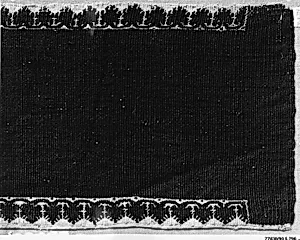
Medium
Wool, linen; plain weave, tapestry weave
Dimensions
Max. H. 25 1/2 in. (64.7 cm) Max. W. 8 1/4 in. (20.9 cm)
Classification
Textiles
Department
Islamic Art
Museum
Metropolitan Museum of Art, New York, NY
Credit
Gift of George F. Baker, 1890
Accession Number
90.5.796
Rights
Public Domain
Art Historical Context
This exquisite Textile Fragment, dating to the 3rd–4th century, offers a rare glimpse into the sophisticated weaving traditions of the early Islamic world. Crafted from wool and linen using plain weave for the foundation and tapestry weave for decorative elements, it exemplifies the technical mastery of ancient artisans. Tapestry weave, where colored weft threads are woven discontinuously to form patterns, allowed for vibrant motifs without wasting precious materials—a clever innovation for creating pictorial designs on garments or furnishings. Housed in the Metropolitan Museum of Art's Islamic Art Department, this fragment (measuring a modest 25½ × 8¼ inches) highlights the cultural exchanges along ancient trade routes, where wool and linen were staples in regions from Egypt to Central Asia. Surviving textiles from this era are exceptionally scarce due to the fragility of fibers, making this piece invaluable for understanding daily life, clothing, and artistic expression in late antique societies transitioning into the Islamic period. A generous gift from George F. Baker in 1890, it invites visitors to appreciate the enduring beauty of humble materials transformed by skilled hands, bridging millennia of human creativity.