
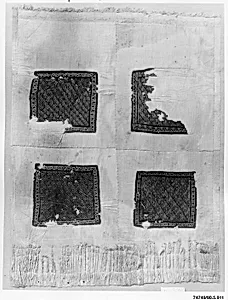
Textile Fragment
Unknown Artist
3rd–4th century
Medium
Linen, wool
Dimensions
Max. H. 45 in. (114.3 cm) Max. W. 42 1/2 in. (108 cm)
Classification
Textiles
Department
Islamic Art
Museum
Metropolitan Museum of Art, New York, NY
Credit
Gift of George F. Baker, 1890
Accession Number
90.5.911
Rights
Public Domain
Art Historical Context
This captivating *Textile Fragment* from the 3rd–4th century, woven from linen and wool, measures an impressive maximum of 45 by 42½ inches, making it a substantial survivor from antiquity. Now treasured in the Metropolitan Museum of Art's Department of Islamic Art, it entered the collection as a gift from George F. Baker in 1890. Such large fragments are rare, as organic materials like these fibers typically perish over time, offering museum visitors a tangible window into a world of skilled handcraft. In the Late Antique period, linen—prized for its fine texture and breathability—was often paired with wool for strength and dye absorption, enabling vibrant woven designs that adorned clothing, furnishings, and possibly burial wrappings. Textiles held immense cultural value, serving as portable art forms that traveled trade routes across the ancient Near East and Mediterranean, influencing later traditions. This piece exemplifies the technical prowess of anonymous weavers, whose interlaced threads preserved patterns reflective of everyday life and regional aesthetics. Though the artist is unknown, the fragment's presence in the Islamic Art collection underscores the continuity of textile arts from pre-Islamic eras into the Islamic world, where such techniques evolved into renowned woven masterpieces. Pause here to imagine fingers deftly at work millennia ago, creating beauty meant to endure.