
Textile Fragment
Unknown Artist
17th century
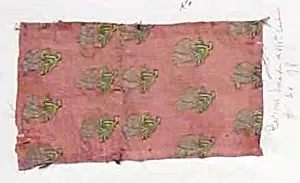
Medium
Silk, metal thread
Dimensions
H. 6 3/4 in. (17.1 cm) W. 4 1/8 in. (10.5 cm)
Classification
Textiles
Department
Islamic Art
Museum
Metropolitan Museum of Art, New York, NY
Credit
Gift of Nanette B. Kelekian, in honor of Olga Raggio, 2002
Accession Number
2002.494.727
Rights
Public Domain
Art Historical Context
This delicate **Textile Fragment** from 17th century offers a glimpse into the opulent world of Islamic art. Crafted from luxurious silk woven with shimmering metal threads—likely gold or silver—this small piece (6 3/4 x 4 1/8 inches) survives as a remnant of a larger textile, a garment, sash, or ceremonial hanging. Such fragments are treasures, preserving intricate patterns that once adorned elite households across the Islamic world, from the Ottoman Empire to Safavid Persia. The use of silk and metal thread highlights masterful techniques like lampas weaving or supplementary weft brocading, where metallic yarns were meticulously couched to catch the light and evoke splendor. These materials symbolized wealth and piety, often featuring motifs of florals, arabesques, or geometric designs that adhered to Islamic aniconism while celebrating nature's beauty. In the 17th century, textiles were a pinnacle of artistic innovation, traded along Silk Road routes and rivaling the finest European tapestries. Now housed in the Metropolitan Museum of Art's Islamic Art Department, this fragment was a generous gift from Nanette B. Kelekian in honor of Olga Raggio in 2002. It invites visitors to marvel at the enduring craftsmanship of anonymous artisans whose work bridged cultures and centuries.