
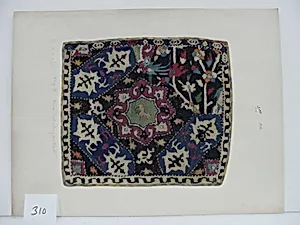
Textile Fragment
Unknown Artist
17th century
Medium
Silk
Dimensions
H. 16 1/8 in. (41 cm) W. 14 in. (35.6 cm)
Classification
Textiles
Department
Islamic Art
Museum
Metropolitan Museum of Art, New York, NY
Credit
Gift of Nanette B. Kelekian, in honor of Olga Raggio, 2002
Accession Number
2002.494.750
Rights
Public Domain
Art Historical Context
This exquisite silk textile fragment the 17th century a glimpse into the opulent world of Islamic art. Housed in the Metropolitan Museum of Art's Department of Islamic Art, it 16 1/8 by 14 inches (41 by 35.6 cm) and survives as a precious remnant, likely from a larger garment, curtain, or ceremonial object. Gifted in 2002 by Nanette B. Kelekian in honor of Olga Raggio it exemplifies the technical mastery of anonymous artisans in the Islamic world during this golden age of textile production. Silk, a luxurious medium prized across the Islamic realms—from the Ottoman Empire to Safavid Persia and Mughal India—was woven with exceptional skill on specialized looms. These fabrics often featured intricate patterns symbolizing paradise gardens, floral motifs, or geometric designs, blending artistry with spiritual resonance. The fragment's survival highlights the fragility and enduring allure of such works, which were traded along the Silk Road and coveted by elites for their sheen, durability, and cultural prestige. Though details of its exact origin remain elusive, this piece invites us to marvel at the ingenuity of 17th-century weavers, whose innovations in dyeing and patterning influenced global textiles. Pause here to imagine it adorning a sultan's hall or a bride's attire—a testament to Islam's rich decorative heritage.