
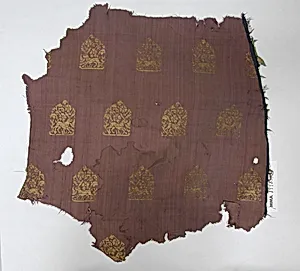
Textile Fragment: Brocaded Tabby with Pattern of Hares
Unknown Artist
13th–mid-14th century
Medium
Silk, metallic thread
Dimensions
Warp 19 11/16 (50 cm); Weft 19 5/16 in. ( 49 cm)
Classification
Textiles-Woven
Culture
China
Department
Asian Art
Museum
Metropolitan Museum of Art, New York, NY
Credit
Gift of Patricia and Henry Tang, 1998
Accession Number
1998.438
Rights
Public Domain
Tags
Art Historical Context
This exquisite textile fragment from 13th- to mid-14th-century showcases the pinnacle of Yuan dynasty weaving artistry. Crafted from luxurious silk with shimmering metallic threads, it measures about 19 by 19 inches and features a lively pattern of hares frolicking across its surface. Hares, often symbols of longevity and fertility in Chinese culture, add a playful yet auspicious motif, reflecting the era's blend of natural motifs and imperial elegance. The piece employs a sophisticated brocaded tabby technique: a plain tabby ground weave (warp and weft interlacing simply for durability) is embellished with supplementary metallic wefts that "broade" the hare designs, creating raised, glittering patterns. This labor-intensive method highlights China's mastery of silk production, a cornerstone of the Silk Road trade, where such textiles were prized for elite garments, hangings, and exports. A gift to the Metropolitan Museum of Art from Patricia and Henry Tang in 1998, this fragment offers a tangible glimpse into Yuan innovation under Mongol rule, when weaving techniques flourished alongside cultural exchanges. Visitors will appreciate its delicate sheen and timeless charm, evoking the opulence of medieval Asian courts.