
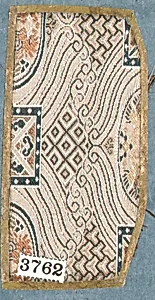
Textile Sample from Sample Book
Unknown Artist
19th century
Medium
Silk / Tapestry
Dimensions
6 x 6 in. (15.24 x 15.24 cm)
Classification
Textiles-Woven
Culture
Japan
Department
Asian Art
Museum
Metropolitan Museum of Art, New York, NY
Credit
Rogers Fund, 1909
Accession Number
09.50.3762
Rights
Public Domain
Art Historical Context
This exquisite 6 x 6-inch silk tapestry hails from a 19th Japanese sample book, a practical yet artistry-filled used by textile merchants to intricate woven patterns to potential clients. Acquired through the Rogers Fund in 1909 and now housed in the Metropolitan Museum Art's Asian Art Department, it exemplifies the precision of Japan's woven textile tradition, where small swatches like this previewed larger bolts destined for kimonos, furnishings, or export goods. In the context of 19th-century Japan—spanning the late Edo and early Meiji periods—this piece reflects a flourishing textile industry renowned worldwide for its technical mastery. Tapestry weaving on silk allowed artisans to create richly detailed, pictorial designs without dyes running, often drawing from nature, mythology, or daily life. Though the specific motif here remains a tantalizing mystery, such samples highlight Japan's blend of utility and aesthetic refinement, bridging domestic craft with emerging global trade. As a woven textile, it invites us to appreciate the labor-intensive Jacquard-like looms or handlooms that produced these vibrant squares, preserving patterns for replication. A window into Edo-era ingenuity, this modest fragment underscores how everyday commerce fueled some of Asia's most enduring artistic legacies.