
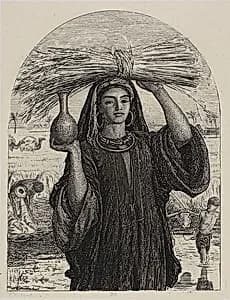
The Abundance of Egypt
Medium
Etching on cream wove chine laid down on off-white wove paper
Dimensions
Image: 13.8 × 10.5 cm (5 7/16 × 4 3/16 in.); Chine: 14.7 × 11.3 cm (5 13/16 × 4 1/2 in.); Plate: 15.5 × 12.2 cm (6 1/8 × 4 13/16 in.); Sheet: 19.1 × 15.3 cm (7 9/16 × 6 1/16 in.)
Classification
etching
Department
Prints and Drawings
Museum
Art Institute of Chicago
Accession Number
117604
Rights
Public Domain
Art Historical Context
William Holman Hunt’s “The Abundance of Egypt” (1857) exemplifies the Pre-Raphaelite interest in biblical narrative and precise observation. Hunt a founding member of the, frequently turned to Old Testament subjects, and this etching likely evokes the seven years of plenty described in Genesis. The compact image rewards close looking, its fine lines suggesting abundant harvests and fertile landscapes that carried moral and spiritual resonance for Victorian viewers. Executed as an etching on chine collé, the work highlights the medium’s capacity for delicate detail and tonal subtlety. By printing on a thin sheet of Eastern paper laid onto a sturdier support, Hunt achieved luminous contrasts and crisp textures that evoke both archaeological authenticity and artistic refinement. Such prints allowed his imagery to circulate widely, extending Pre-Raphaelite ideals beyond the Royal Academy to a broader public. Though small in scale—roughly five by four inches—the etching distills Hunt’s larger ambitions: to fuse meticulous technique with symbolic depth. Today it offers museum visitors an intimate window onto mid-nineteenth-century Britain’s fascination with Egypt, scripture, and the possibilities of printmaking.