
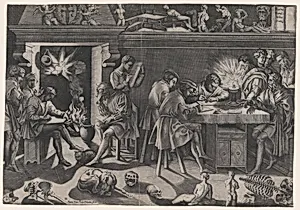
The Academy of Baccio Bandinelli
Medium
Engraving; first state of two
Dimensions
sheet: 12 1/16 x 17 1/4 in. (30.6 x 43.8 cm)
Classification
Prints
Department
Drawings and Prints
Museum
Metropolitan Museum of Art, New York, NY
Credit
Purchase, Joseph Pulitzer Bequest, 1917
Accession Number
17.50.16-135
Rights
Public Domain
Tags
Art Historical Context
This engraving, created around 1544, offers a fascinating glimpse into the artistic world of Renaissance Italy. Attributed to engraver Enea Vico after designs by sculptor Baccio Bandinelli and published by Pietro Paolo Palumbo, the print depicts Bandinelli’s renowned academy—a lively studio where artists gathered to study drawing, anatomy, and classical forms. The first state of two captures the bustling energy of this environment, complete with figures clustered around fireplaces and a prominent skeleton, highlighting the era’s emphasis on scientific observation in art. Bandinelli, a prominent Florentine sculptor and contemporary of Michelangelo, established his academy as a center for training young artists in the rigorous techniques of the time. Engravings like this one played a vital role in disseminating knowledge, allowing wider audiences to study compositional ideas and workshop practices that were once limited to elite circles. The detailed line work of the medium underscores the precision valued in Renaissance printmaking. Housed in the Metropolitan Museum of Art’s collection of drawings and prints, this work reflects the collaborative spirit of 16th-century art production. Its depiction of men and women engaged in study alongside anatomical elements speaks to the period’s growing interest in human form and shared learning.
About the Artist
Enea Vico|Baccio Bandinelli|Pietro Paolo Palumbo · 1523–1567
Enea Vico (1523–1567) was born in Parma and came of age during the final, energetic decades of Italian Renaissance printmaking. By 1541 he had made his way to Rome, where he entered the orbit of the engraver and publisher Tommaso Barlacchi and began his professional career. In Rome, Vico encountered the work of the most celebrated printmakers of the preceding generation—Marcantonio Raimondi, Agost...